
OEM Solutions › Memory Modules › DDR2

Legacy systems

DDR2 Memory Modules

For older industrial and embedded systems still in service.

Other generations

Legacy systems

DDR2

  • UDIMM
  • 533 to 800 MT/s

Find your part

Filter by interface, ECC, speed and size.

Item No. Tech Interface Control ECC Speed Size Rank Config CL Temp Info
S3-D2DUN2CD-1G.A0 DDR2 DIMM Unbuffered Non-ECC PC2-4300 (533MT/s) 1GB 2 64Mb x8 Commercial
S3-D2DUN2CD-2G.A0 DDR2 DIMM Unbuffered Non-ECC PC2-4300 (533MT/s) 2GB 2 128Mb x8 Commercial
S3-D2DUN2CD-4G.A0 DDR2 DIMM Unbuffered Non-ECC PC2-4300 (533MT/s) 4GB 2 256Mb x8 Commercial
S3-D2DUN2CD-512MB.A0 DDR2 DIMM Unbuffered Non-ECC PC2-4300 (533MT/s) 512GB 2 32Gb x8 Commercial
S3-D2DUN2CD-8G.A0 DDR2 DIMM Unbuffered Non-ECC PC2-4300 (533MT/s) 8GB 2 512MBx8 Commercial
S3-D2DUN2CB-1G.A0 DDR2 DIMM Unbuffered Non-ECC PC2-5300 (667Mhz) 1GB 2 64Mb x8 Commercial
S3-D2DUN2CB-2G.A0 DDR2 DIMM Unbuffered Non-ECC PC2-5300 (667Mhz) 2GB 2 128Mb x8 Commercial
S3-D2DUN2CB-4G.A0 DDR2 DIMM Unbuffered Non-ECC PC2-5300 (667Mhz) 4GB 2 256Mb x8 Commercial
S3-D2DUN2CB-8G.A0 DDR2 DIMM Unbuffered Non-ECC PC2-5300 (667Mhz) 8GB 2 512MBx8 Commercial
S3-D2DUN2CC-1G.A0 DDR2 DIMM Unbuffered Non-ECC PC2-6400 (800Mhz) 1GB 2 64Mb x8 Commercial
S3-D2DUN2CC-2G.A0 DDR2 DIMM Unbuffered Non-ECC PC2-6400 (800Mhz) 2GB 2 128Mb x8 Commercial
S3-D2DUN2CC-4G.A0 DDR2 DIMM Unbuffered Non-ECC PC2-6400 (800Mhz) 4GB 2 256Mb x8 Commercial
S3-D2DUN2CC-512MB.A0 DDR2 DIMM Unbuffered Non-ECC PC2-6400 (800Mhz) 512GB 2 32Gb x8 Commercial
S3-D2DUN2CC-8G.A0 DDR2 DIMM Unbuffered Non-ECC PC2-6400 (800Mhz) 8GB 2 512MBx8 Commercial
No products match these filters.
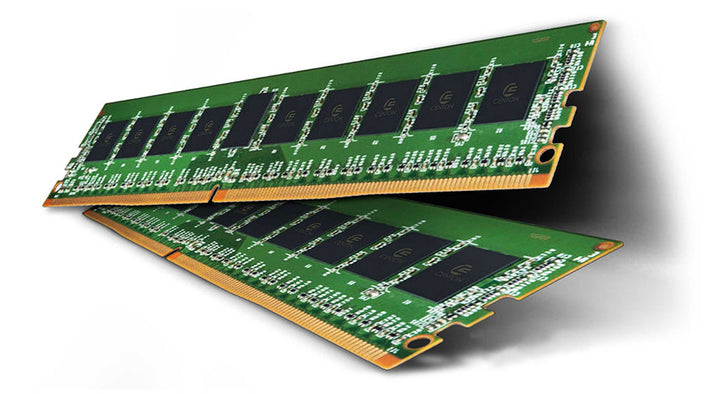
Media image 1

About the Technology

About DRAM memory modules
Centon DRAM memory modules pair JEDEC-standard DDR DRAM with rigorously qualified components on a controlled bill of materials. Available in unbuffered (UDIMM), registered (RDIMM), and small-outline (SODIMM) form factors across DDR3, DDR4, and DDR5 generations, in ECC and non-ECC configurations to match server, workstation, industrial-PC, and embedded designs. Optima offers BOM control, and Optima+ locks the full BOM with a new part number on any change. Both come with SPD customization, post-production testing and long-lifecycle supply for OEM and system-builder programs.
ECC vs. non-ECC and registered memory
ECC (error-correcting code) modules add an extra DRAM device that lets the memory controller detect and correct single-bit errors on the fly, important for servers and any system where silent data corruption is unacceptable. Non-ECC modules omit that device and are typical in desktops and many embedded designs. Registered (buffered) memory, RDIMMs, places a register between the controller and the DRAM to reduce electrical load, allowing more modules and higher total density per channel; unbuffered memory (UDIMM and SODIMM) connects the controller directly for lower latency in smaller configurations. Your CPU and chipset dictate which type is supported, so the module must match the platform.
1 rank vs. 2 rank: which to choose
Rank refers to how many independent sets of DRAM chips a module can address at once. A single-rank (1Rx) module presents one set of DRAM to the memory controller per access; a dual-rank (2Rx) module presents two, doubling the addressable chip select lines on the same module. Single-rank modules are simpler for the memory controller to drive and typically support higher speed grades at a given density, so they are the safer default when your platform's controller has limited rank support or you are running near the top of its supported speed. Dual-rank modules pack more capacity onto one module and let a system reach higher total memory with fewer physical slots, which matters most in servers and workstations that are capacity constrained rather than speed constrained. Check your platform's maximum supported ranks per channel and per DIMM before specifying either configuration.
DDR3, DDR4 and DDR5 generations
DDR (Double Data Rate) DRAM advances by generation: DDR3, DDR4, and DDR5. Each generation lowers operating voltage, raises bandwidth, and changes the physical key/notch, so modules are not cross-compatible between sockets: a board designed for one generation accepts only that generation. DDR5 also moves power management onto the module and splits each module into independent sub-channels. Choose the generation your CPU and motherboard support; the spec table on this page lists the generation, form factor, and pin count for each part.
What is CDIMM/CSODIMM?
CDIMM and CSODIMM are DDR5-specific variants of the standard DIMM and SODIMM form factors that add a client clock driver on the module. At DDR5's higher data rates, distributing the clock signal directly from the host controller loses too much signal integrity across the channel, so the on-module clock driver regenerates and redistributes it to each DRAM device, which is what lets the higher speed grades run reliably. Mechanically, CDIMM and CSODIMM are pin-compatible with standard DIMM and SODIMM sockets, so moving between them does not require a board redesign. As DDR5 speed grades climb, more designs are qualifying with the clocked variant.
Designing in: what engineers should check
When qualifying a module into a design, engineers typically confirm more than density: the JEDEC raw-card revision and DRAM organization, the SPD timing profile (which Centon can customize for your platform), module height and form factor for mechanical clearance, ECC and registered support on the target chipset, the operating temperature grade, and component-level BOM control so the module you qualify is the module you receive for the life of the program. With Optima+, Centon assigns a new part number on any BOM change. Centon also offers post-production burn-in and application validation, so a qualified build stays fixed.

Service-backed

More than parts

Our services →
  • Inventory managementStock held for your program.
  • CustomizationLabels, firmware and packaging.
  • Long-lifecycle supplyBuilt as long as parts are available.
  • Engineer supportDirect help from our engineers.